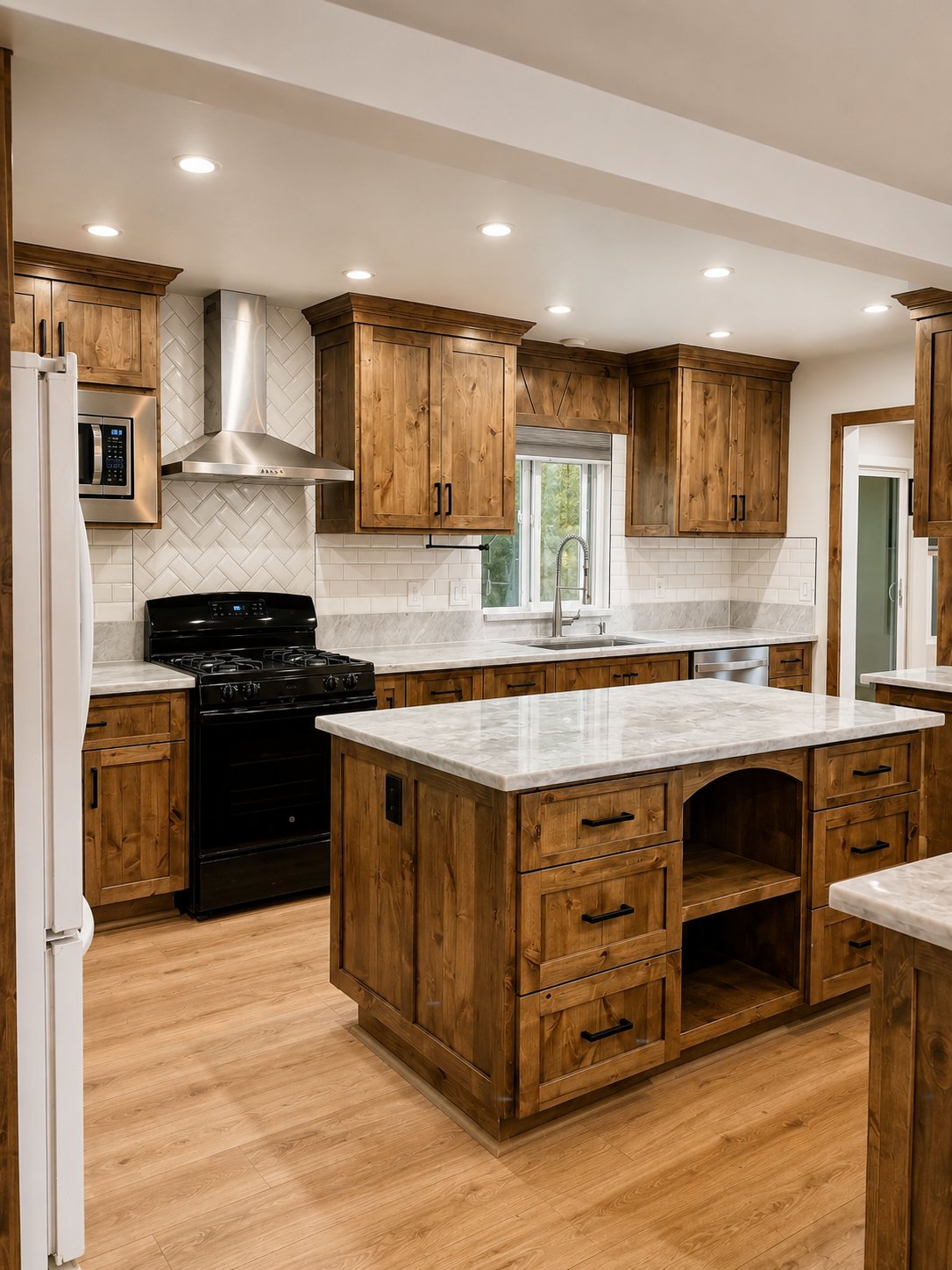
When a kitchen feels dated, there are three honest ways to fix the cabinets: refinish them, reface them, or replace them entirely. All three are valid — the right one depends on the condition of your cabinet boxes, your budget, and how much disruption you're willing to live with. The short version is that if your boxes are sound, refinishing gives you most of the transformation for the least cost and the least mess. Here's how the three compare, so you can choose with confidence.
The three options, defined
It's worth being precise, because the words get used loosely. Each option changes a different amount of your kitchen.
Refinishing
Refinishing keeps your existing doors, drawers, and boxes and changes the finish — we clean, sand, prime, and spray a new color or coating onto the cabinetry you already have. Nothing is torn out. It's the lowest-cost path to a dramatically different kitchen and the least disruptive to live through.
Refacing
Refacing keeps the cabinet boxes but replaces the doors and drawer fronts, with a matching veneer applied over the visible box frames. You get new door styles and hardware without a full tear-out — more change than refinishing, and more cost, but far less than starting over.
Replacing
Replacing removes everything — boxes, doors, and drawers — and installs all-new cabinetry. It's the only option that lets you change the layout or correct failing boxes, and it's by far the most expensive and disruptive of the three.
Side-by-side comparison
Here's how the three stack up on the factors that usually decide the question. Cost is shown in relative terms — every kitchen is different, and a real number comes only from an on-site look.
| Factor | Refinishing | Refacing | Replacing |
|---|---|---|---|
| What changes | New finish or color on existing doors and boxes | New doors and drawer fronts; veneer on the boxes | All-new cabinetry, boxes included |
| Relative cost | $ — a fraction of replacement | $$ — mid-range | $$$ — the most |
| Timeline | Shortest — often about a week | Moderate | Longest |
| Disruption | Lowest — boxes stay in place | Moderate — boxes stay, fronts swapped | Highest — full demolition and install |
| Best when | Boxes are structurally solid and you want a new look | Doors are dated or damaged but boxes are good | Boxes are warped or water-damaged, or the layout is changing |
Read down the table and the trade-off is clear: as you move from refinishing toward replacement, you gain the ability to change more of the kitchen — but you pay more, wait longer, and live with more disruption to get there.
When refinishing wins
For most kitchens with solid cabinets, refinishing is the value play. If your boxes are sound — solid wood or quality MDF that's square and dry — and you're happy with the layout, refinishing changes everything you actually see for the least money and mess. You keep your existing cabinetry and hardware footprint, skip demolition entirely, and get a fresh, sprayed finish in roughly a week instead of weeks. It's also the smart move when you love your kitchen's bones but the color reads dated. For the full method behind a lasting result, see our page on professional cabinet refinishing, and if you're in the Truckee Meadows, our page on cabinet refinishing in Reno covers local detail.
The cabinets are usually the most expensive thing in the kitchen. When the boxes are still good, refinishing lets you keep that investment and change everything you see.
When refacing or replacing wins
Honesty matters here, so we'll say it plainly: refinishing isn't always the answer. Refacing is the right call when your boxes are solid but the doors themselves are beyond saving — split, swollen, or a style you simply can't live with — and a new finish on old doors wouldn't do them justice. Replacing is the right call when the boxes are warped, water-damaged, or failing, or when you want to reconfigure the kitchen's layout, add an island, or move appliances. No finish or veneer fixes a structural problem or moves a wall. When we see that in person, we'll tell you — recommending refinishing on cabinets that need replacing would only cost you twice.
Get expert guidance before you decide
The cleanest way to choose is to have someone who does all three look at your actual cabinets. In a short visit we check whether the boxes are sound, assess the doors, and talk through your goals and budget — then give you straight counsel on which path fits, with no pressure toward the most expensive one. If you're also weighing the numbers, our guide on the cost to refinish kitchen cabinets in Reno walks through what actually drives the price. And if a refresh has you rethinking color, a color consultation helps you commit with confidence.
At Ambition Painting, we help homeowners across Northern Nevada and Lake Tahoe make the right call for their kitchen — and then deliver a finish worthy of the home you've built. If you're staring at tired cabinets and weighing your options, we're glad to take a look and give you an honest answer. Quality. Precision. Ambition.