Closing the doors — even for a weekend — costs real revenue, and it's the first worry we hear from every business owner planning a repaint. It doesn't have to be that way. With the right sequencing, the right paint, and a schedule built around your hours instead of ours, an office, storefront, or multi-tenant property can get a full professional refresh without losing a single operating day. Here's how that schedule actually comes together.
Start with a walkthrough, not a start date
The mistake most businesses make is picking a start date before anyone has walked the space. A commercial repaint that respects your operations starts with a site visit: which areas see foot traffic all day, which close early, where the loading dock is, what needs to stay accessible for deliveries or after-hours staff. That walkthrough is what turns a generic quote into a real plan — one that accounts for your lobby hours, your busiest sales days, and any equipment or inventory that needs to be protected rather than moved.
Break the project into zones, not one big job
Instead of painting a building start-to-finish, a commercial repaint gets broken into zones — a wing, a floor, a suite, a storefront — so one area is always open while another is being finished. A multi-tenant office might get one wing at a time. A retail center might get one storefront's exterior facade per week. This is the single biggest lever for keeping a business open: the work moves through the building in pieces small enough that customers and staff barely notice, instead of one disruptive push that shuts everything down at once. It's the same phased approach we use across offices, retail, and multi-unit properties throughout the region.
Choose paint built for occupied spaces
Not every coating belongs in a building that stays open during the job. Low-VOC, fast-recoat products cut both the odor and the wait — a coat that's dry to the touch and safe to reopen in hours instead of overnight keeps a phased schedule realistic. For occupied interiors like lobbies, corridors, and conference rooms, that product choice matters as much as the schedule itself; the fastest zone-by-zone plan in the world doesn't help if the paint itself needs a full day to off-gas before people can walk back in.
Schedule around the clock, not around the calendar
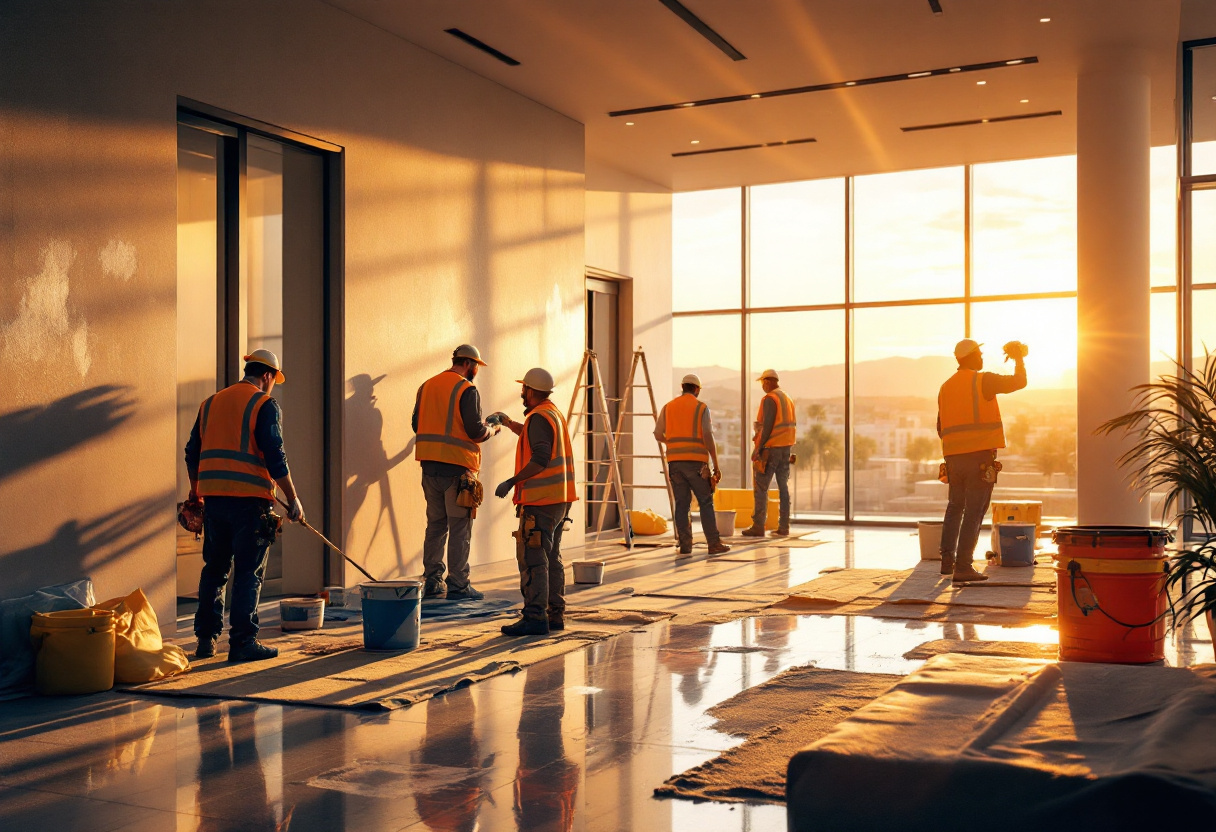
After-hours, overnight, and weekend crews are what actually make a zero-downtime repaint possible. A crew arrives after close, works through the evening or overnight, and clears out — floors clean, tools packed, walkways clear — before your first customer or employee walks in the next morning. On longer projects, that cadence repeats zone by zone until the whole property is done. It's a different rhythm than a residential job, but it's standard practice for commercial properties across Reno and the surrounding valley, where a business simply can't afford a closed sign.
The best commercial repaint is the one your customers never have to plan around.
Protect what your customers see
An occupied building has to look presentable at every stage, not just at the end. That means masking and containment that hold up overnight, drop cloths and equipment staged out of walkways before doors open, and a clear line between the work zone and the public one. Nothing scuffs the brand impression of a business faster than a sloppy job site greeting the first customer of the day — so the cleanup routine is as much a part of the schedule as the painting itself.
Loop in the people who need to know
Commercial projects rarely involve just an owner. Facility managers, general contractors, and property management teams usually need to sign off on access, badge or key arrangements, and documentation like certificates of insurance before a crew ever shows up. Getting that paperwork and those approvals settled during the walkthrough — not the week of — is what keeps a tight schedule from slipping. It's a coordination step that matters just as much on a single-tenant office as it does on a multi-building HOA or property management portfolio.
Time exterior work around the weather window
Storefront facades and exterior signage bands follow the same seasonal logic as any exterior repaint in this region — temperature, humidity, and the risk of an early freeze all affect cure time. We cover the residential side of that timing in our guide to the best time of year to paint an exterior in Northern Nevada, and the same principles apply to a commercial facade: booking early in the season protects both the finish and the schedule, since a rushed exterior job squeezed into a shrinking weather window is far more likely to run into delays.
What this looks like in practice
Picture a strip retail center with six storefronts. Rather than close the plaza for a week, the work gets sequenced one storefront at a time, overnight, starting with the unit furthest from the busiest anchor tenant. Each morning, that storefront reopens on schedule while the crew moves to the next unit that evening. By the time the whole center is finished, every tenant has stayed open for every trading day — and the property looks uniform and freshly finished from one end to the other. The same logic scales down to a single office suite or up to a full multi-building property; only the number of zones changes.
At Ambition Painting, we build every commercial schedule this way — walkthrough first, zones mapped, after-hours crews locked in, and the paperwork handled before day one. We're licensed and insured for commercial work across Reno, Carson City, the Carson Valley, and Tahoe's Nevada shore, and we coordinate directly with facility managers, GCs, and property teams so the plan fits your operation, not the other way around. Quality. Precision. Ambition.