Ask three garage-floor contractors what coating to use and you may get three different answers, because "epoxy" gets used as a catch-all for a job that's actually built from two distinct technologies. Epoxy and polyaspartic solve different problems — cure speed, sun exposure, and flexibility — and the honest answer for most Nevada garages isn't picking one over the other. It's understanding what each does, so you know exactly what you're paying for.
What's actually the difference?
Epoxy is a two-part resin and hardener system that chemically bonds into a thick, hard film once it's mixed and applied. It's the workhorse base coat of the floor-coating world: it lays down heavy build, locks decorative flake in place, and forms a strong mechanical bond to properly ground concrete. Polyaspartic (a fast-curing aliphatic polyurea chemistry) is a different animal — thinner, far quicker to cure, more flexible, and much more resistant to UV light. On most professional jobs, polyaspartic isn't a replacement for epoxy so much as a partner to it: the epoxy does the heavy lifting underneath, and the polyaspartic seals and protects on top.
Cure time: days vs. hours
This is the difference homeowners feel first. Standard epoxy needs real time to cure — typically a day or more before you can walk on it, and several days to a week before it's ready for vehicle traffic. Polyaspartic cures dramatically faster: many systems can be walked on the same day and driven on within 24 to 48 hours. If your household has one garage and no patience for parking in the driveway for a week, that gap alone often decides the system.
Sun, UV & the high-desert light
Nevada's elevation and clear skies mean more direct UV exposure than most coatings see in a typical American garage — and it shows. Standard epoxy isn't fully UV-stable; over time, sun through an open door or a window can cause it to amber or yellow, especially near the apron where light hits hardest. Polyaspartic resists that yellowing far better, which is exactly why it's the go-to top coat for garages that see real sun — a common story for homes across Reno and Carson City with south-facing driveways.
The floor that still looks new in five years usually isn't the one with the thickest epoxy — it's the one with a UV-stable top coat protecting it.
Temperature range & the installation window
Epoxy has a narrower comfort zone during application and cure — cold snaps common in Sierra winters or at Tahoe elevation can slow the cure or affect how it lays down, which is part of why timing a coating project matters as much as the product itself. Polyaspartic tolerates a wider temperature range going down and while curing, giving installers more usable weeks on the calendar — useful in a region where a warm fall afternoon can turn into a freezing morning by the weekend.
Durability, flexibility & chemical resistance
Both systems resist motor oil, road salt, and solvents far better than bare concrete, but they fail differently under stress. Epoxy is very hard, which makes it durable underfoot but a bit more brittle — a hard enough impact can chip it. Polyaspartic stays more flexible as it cures, which helps it absorb impact and resist the hot-tire pickup that lifts weaker coatings off the slab. Neither weakness is dealbreaker; it's simply another reason the two are often layered rather than treated as competitors.
Cost: it's closer than it looks
Polyaspartic material typically costs more per gallon than epoxy. But because it cures so much faster, labor time drops and your garage spends far fewer days out of commission. Run the full math — materials, labor days, and the cost of not parking in your garage for a week — and the two systems often land closer together than the sticker price on the bucket suggests. The better question isn't which is cheaper; it's which fits your timeline and how the space actually gets used.
Why most professional floors use both
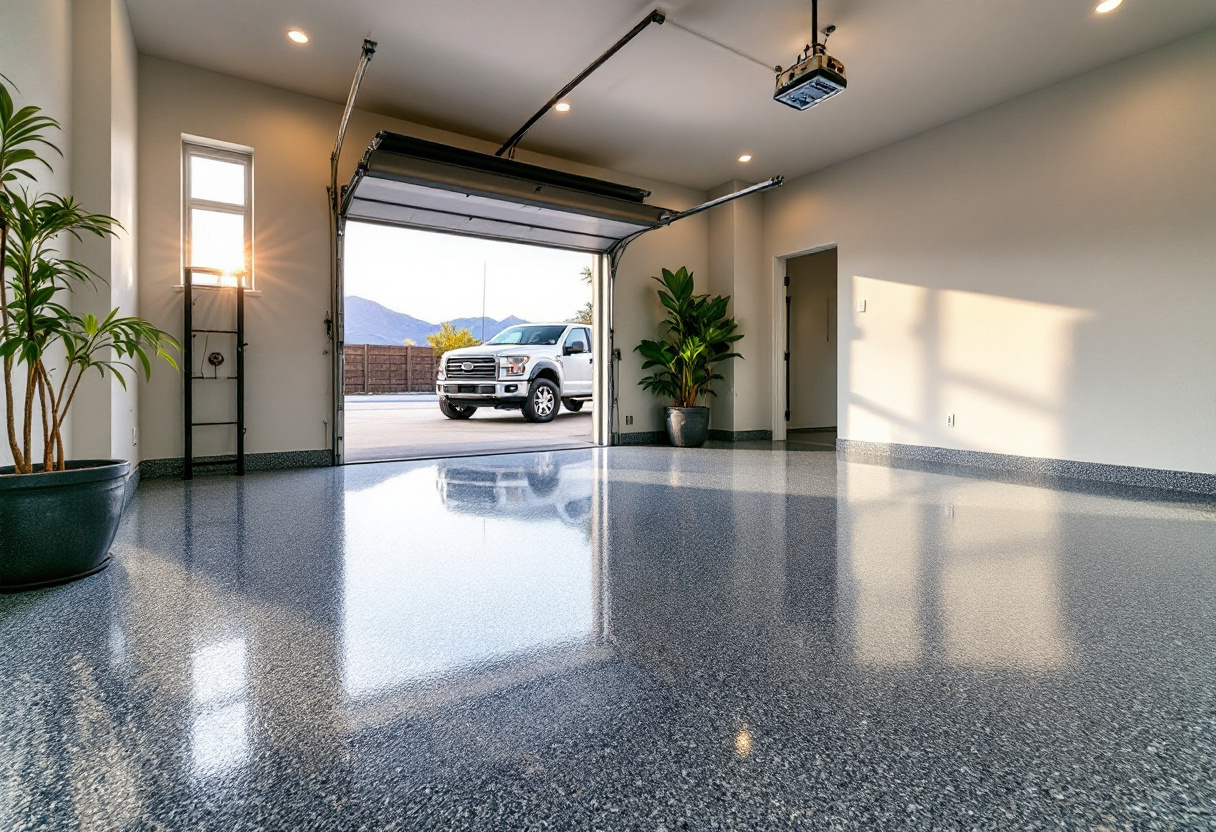
In practice, the epoxy-vs-polyaspartic debate is a bit of a false choice. A hybrid system — a ground-in epoxy base coat carrying color and decorative flake, sealed under a polyaspartic top coat — gives you the build and bond of epoxy with the speed, UV stability, and flexibility of polyaspartic. It's the system we install by default across our garage floor coating projects, because it outperforms either chemistry running solo, and it still depends on the same non-negotiable first step: diamond-grinding the concrete so everything above it actually bonds.
Which one is right for your garage?
- Need the garage back fast? Lean polyaspartic-heavy — same-day walk, next-day drive.
- South-facing door that's open a lot? Make sure a polyaspartic top coat is protecting the color underneath.
- Installing during a cold snap or at higher elevation? Polyaspartic's wider temperature range keeps more days on the calendar workable.
- Want the longest-lasting, most complete system? A hybrid epoxy base with a polyaspartic seal covers every column above.
At Ambition Painting, we walk every homeowner through this decision before a single tool touches the slab — because the right system depends on your garage's sun exposure, your timeline, and how hard the floor actually gets used, not a one-size-fits-all sales pitch. Homeowners in Reno can see local specifics on our Reno garage floor epoxy page, and homeowners at the lake can check our Lake Tahoe service area. Or just get in touch and we'll tell you honestly which system your garage needs. Quality. Precision. Ambition.