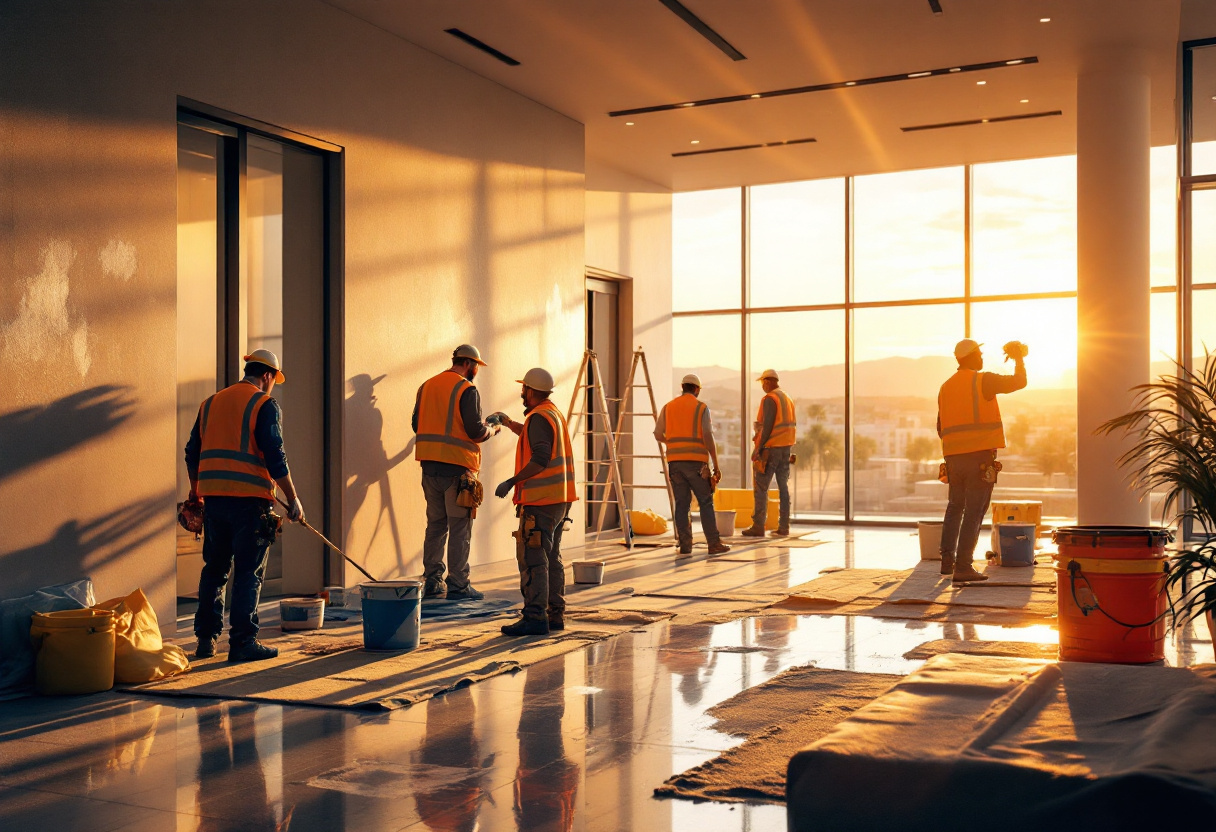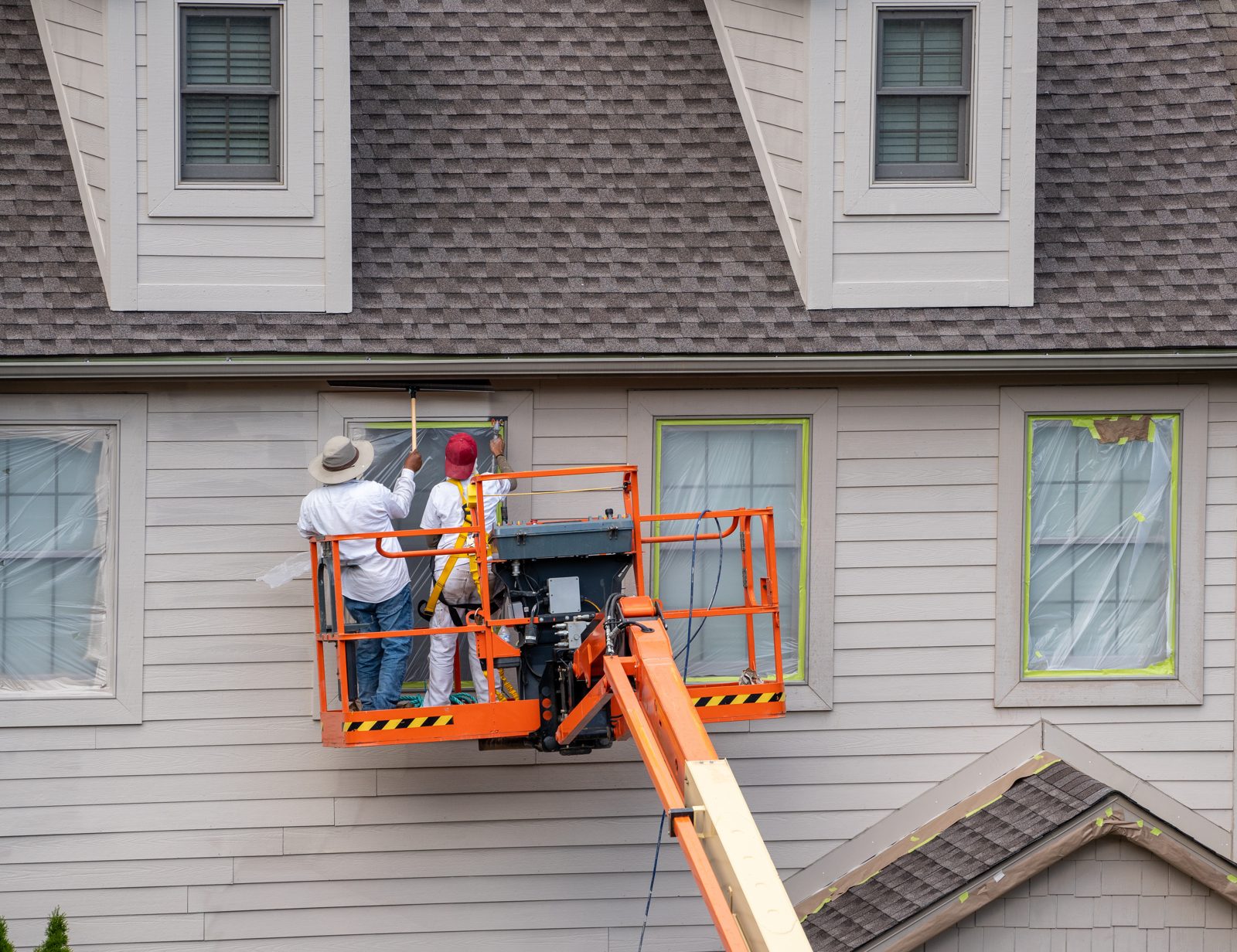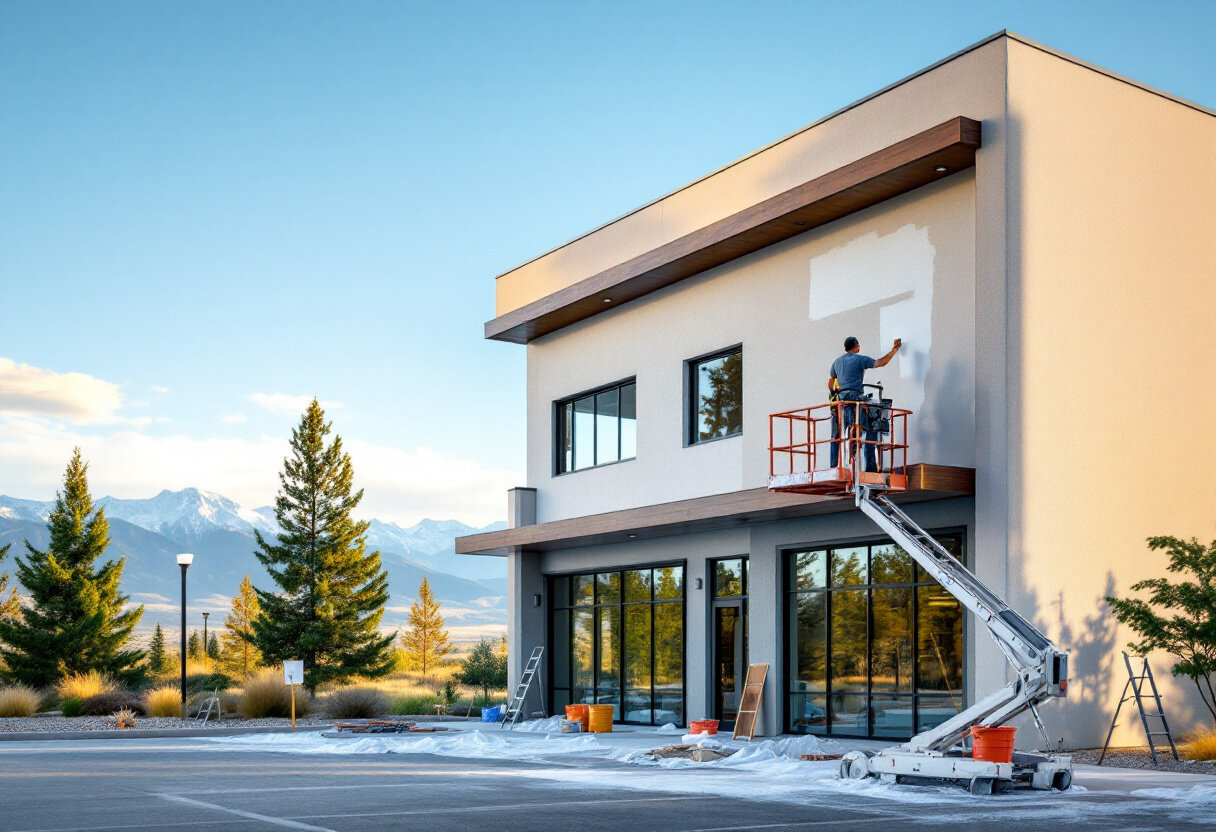
A commercial building’s paint is doing two jobs at once: it’s the first thing a customer judges you on, and it’s the weather seal protecting everything underneath. When it starts to fade, chalk, or peel, both jobs fail together — your storefront looks tired and moisture starts finding its way into the substrate. So the real question isn’t just “when does it look bad,” it’s “when does waiting start costing me money.” Here’s a realistic timeline for repainting a commercial property in Reno, Carson City, and the Carson Valley, and why the Sierra climate moves the clock faster than the national averages suggest.
The short answer
Most commercial exteriors need repainting every 5 to 10 years. That’s the range you’ll see quoted nationally, and it’s a fine starting point — but it’s a wide range for a reason. The right number for your building depends on what it’s made of, which direction its walls face, how much sun and traffic they take, and how well the last paint job was done. In Northern Nevada, the combination of altitude, UV, and freeze-thaw tends to push buildings toward the shorter end of that window.
High-traffic commercial interiors run on a faster cycle. Lobbies, corridors, restrooms, and anything with constant hand or cart contact usually want a refresh every 3 to 5 years to stay clean and professional, while lower-traffic offices can stretch longer.
Why paint fails faster here
If you’ve watched a sign or a south-facing wall go chalky years ahead of schedule, you’ve seen the Sierra climate at work. Three forces do most of the damage:
- High-altitude UV. Ultraviolet light is dramatically stronger at Reno and Carson City elevations than at sea level, and UV is what breaks down the resins that bind a coating together. That’s what turns a rich color flat and powdery.
- Freeze-thaw cycling. The region swings above and below freezing much of the year. Every time moisture gets behind the film, freezes, and expands, it pries at the bond between paint and wall — the same cycle that destroys builder-grade exterior paint around Tahoe and Reno.
- Dry, dusty, sun-baked air. High-desert wind carries fine abrasive dust, and the low humidity bakes surfaces that face the afternoon sun.
The practical takeaway: your south- and west-facing elevations will almost always fail first. It’s common for one or two walls to need attention a few years before the rest of the building does.
Paint doesn’t usually fail all at once — it fails on the wall the sun hits hardest, years before the shaded side shows a thing.
A realistic timeline by material
Different surfaces age on different schedules. These are planning ranges for a well-applied finish in our climate — an inspection is the only way to pin down your building:
- Stucco & EIFS: roughly 6 to 8 years. Durable, but hairline cracks open with freeze-thaw and need to be addressed at repaint.
- Concrete block (CMU) & masonry: 7 to 10 years with the right breathable coating; longer if it was done properly the first time.
- Metal & steel (panels, doors, columns): 4 to 8 years. Watch for chalking and any spot of rust, which spreads fast once it starts.
- Wood siding, trim, and fascia: 3 to 5 years. Wood moves with moisture and takes the most maintenance — the same reality that governs how often a Tahoe cabin exterior needs repainting.
- Doors, railings, and high-touch trim: often the first things to look worn, regardless of the walls.
The signs it’s already time
Don’t wait for the calendar if the building is telling you sooner. Walk the exterior and look for:
- Fading or color loss, especially uneven fading between sun-exposed and shaded walls.
- Chalking — a powdery residue that rubs off on your hand. It’s the clearest sign UV has degraded the binder.
- Peeling, flaking, or blistering, which means the bond has already let go and moisture is getting in.
- Cracked or failed caulk around windows, doors, and joints — the entry points water exploits first.
- Stains, mildew, or rust streaks that won’t wash off.
Any of these means the coating has stopped protecting the structure. At that point, repainting isn’t cosmetic maintenance — it’s preventing the far more expensive repairs that follow water intrusion into stucco, wood, or steel.
Why repainting on schedule is cheaper than waiting
It’s tempting to stretch a commercial repaint “one more year.” The math usually argues against it. A coating applied before it fully fails goes over a sound surface, which means less prep, fewer repairs, and a straightforward job. Wait until the film has broken down and you’re now paying to fix cracked stucco, replace rotted trim, or treat rust before anyone can even pick up a roller.
There’s a revenue side, too. A faded, peeling exterior quietly tells every customer and tenant that the business isn’t being kept up. For retail, offices, and hospitality, curb appeal is marketing you’ve already paid for — letting it degrade is leaving that value on the table. Professional commercial painting protects both the asset and the impression.
How to make a repaint last the full interval
The spread between a coating that lasts three years and one that lasts ten comes down to two things: preparation and products. The surface has to be cleaned, failed caulk and substrate repaired, and the right primer applied before a single finish coat goes on. Over that, premium 100% acrylic or, where appropriate, elastomeric coatings rated for UV and freeze-thaw are what buy you the long end of the range. The same prep-first logic that makes an exterior paint job endure a Sierra winter applies at commercial scale — just across far more square footage and exposure.
Timing matters as well. Exterior coatings need dry weather and moderate temperatures to cure properly, which is why the planning window is worth getting right — our guide to the best time of year to paint an exterior in Northern Nevada walks through the ideal months for Reno, Carson City, and Tahoe.
Repainting without shutting down
For most owners, the real worry isn’t the paint — it’s the disruption. The good news is that a commercial repaint is scheduled around your operation. Work happens after hours, on weekends, or in phased zones so one area stays open and customer-facing while another is being finished, and fast-cure, low-odor coatings let a space be ready for business the next morning. We cover the whole playbook in how to schedule a commercial repaint without closing your doors.
Whether you manage a storefront in Reno, an office or medical building in Carson City, or a multi-tenant property in Minden & Gardnerville, the sequence is built to keep you running.
Not sure where your building stands? Let’s take a look
The honest answer to “how often” always comes from the building itself, not a chart. At Ambition Painting, we’ll walk your property, tell you which elevations are due now and which can wait, and lay out a repaint plan that protects the structure and keeps your doors open. If your exterior is fading, chalking, or past the 7-year mark, it’s worth a free, no-obligation assessment of your commercial painting needs. Quality. Precision. Ambition.